Showing posts with label Robert R "Bob" Church. Show all posts

Tuesday, April 10, 2018

The First Penny


They called him Colonel Galloway. That’s odd, because during the War Between the States he was General Nathan Bedford Forrest’s Aide-de-camp, and I’m not certain his position carried a rank in the Confederate Army.  I can’t prove it, but I suspect he held the rank of Colonel in one of Memphis’s home guard militias (Memphis Minute Men perhaps) that was formed between 1857, when he arrived in Memphis, and late June of 1862 when he left Memphis to fight the Union invaders on other fronts.

Before and after the war, Galloway was the editor and part owner of the Avalanche, a staunch Democrat newspaper that never backed down from defending the cause of the South long after the war was over.

By mid June of 1862, Federal authorities in Memphis had suspended the Avalanche and Galloway was in Grenada, MS. His wife, Fannie Barker Galloway stayed behind in their house on the northeast corner of Court and Third.

Like another notable Confederate Memphis wife, Mrs. Elizabeth Avery Meriwether, Mrs. Galloway was expelled from Memphis by the Union occupiers. Mrs. Meriwether would be exiled by General Sherman in response to guerrilla activity in and around West Tennessee. Mrs. Galloway, who was suspected of passing information to the Confederates, was forced to leave days before Grant issued his infamous Special Order No. 14 (later revised and reissued as Special Order No. 15). 


Galloway revived the Avalanche by New Year’s Day of 1866 in a Memphis that remained under Federal occupation and was overrun not only by black soldiers, carpetbaggers, and abolitionist teachers, but by thousands of formerly enslaved people who mostly occupied South Memphis, Presidents Island, and Fort Pickering (the area south of the Overton Tract and the Mississippi and Tennessee Rail Road depot.

If that wasn’t bad enough, the city itself was in the hands of Irish Fenians who apparently ran roughshod over a drunken mayor, and most of the old citizens had been disfranchised as a consequence of their loyalties.

Five months later, the day the last black soldiers in Memphis were mustered out of the Union Army (and thus disarmed), the Irish cops instigated a three day massacre that targeted blacks who were beginning to enjoy a measure of economic success and making remarkable advances in their children’s education.

The role Galloway and the Avalanche played in the atrocities can’t be ignored. It was the Avalanche that laid the blame for the atrocities squarely on the heads of the blacks themselves. When we consider that the investigations revealed that aforementioned abolitionist teachers were on the mobs' (plural) hit lists, it’s more than a little odd that the the Avalanche's call for restraint marked the end of the violence.


In the course of the (politically motivated) investigations that followed, it was made clear by the “old citizens” that they deplored the actions of the low born Irish, but that they were rendered helpless by order of General Stoneman. What is missing from their denouncements is any effort or expression of desire to hold the guilty parties accountable after the fact. Worse was the lack of aid to help South Memphis recover from the losses.

The massacre of 1866 was followed by the appearance of the KKK in Memphis in 1867.

In Chapter XXIV of her memoir, Recollections, Elizabeth Avery Meriwether herself rationalizes the atrocities committed by the KKK (her husband, Minor, was one of “Supreme Grand Wizard” Forrest’s counselors and lieutenants), and reveals how Galloway played a role in obscuring the mere existence of the outlaw organization.

Fast forward ten years.

General Nathan Bedford Forrest died on the twenty-ninth of October, 1877 and the funerary rites that followed were the topic of National news. The local papers that reported on the proceedings read like a who’s who of Memphis and the Mid South, unless you count the absence of the Independent Order of Pole Bearers or any other notable black people.

The year after that, 1878, yellow fever made its annual appearance in Memphis, and it wouldn’t leave until October because it was accompanied by the warm mosquito friendly winds of El NiƱo. The old citizens (with notable exceptions, the Mayor for example) fled the city, and for the first time in our History, Memphis had a black majority. Who is going to say they didn’t protect and indeed rescue Memphis that year?

Of course, the white families who returned to Memphis properly thanked them, and then proceeded to send them back to South Memphis.

I would say that things went back to business as usual, but 1878 was two years after Hayes-Tilden, one year after the death of Gen N B Forrest, and less than a year before Memphis surrendered her charter.

Eighteen seventy nine was a significant year for our purposes because that was the year that M C Galloway donated the very first penny for the Forrest monument.


Let’s be careful about how we throw the “white supremacist” label around, but it is clear that M C Galloway did believe that white supremacy was a natural, if not God ordained, fact of life (I suspect a number of black people believed it as well).

It would be twenty six years before the monument was installed, and Memphis's attitude of white supremacy hardly changed for the better, what with lynch law, the pattern of bartering for and coercing black votes, and the ascendancy of a very young E H Crump that marked the turning of the century.

More specific to the funding of the statue, I have to wonder why Bob Church’s support is never mentioned.

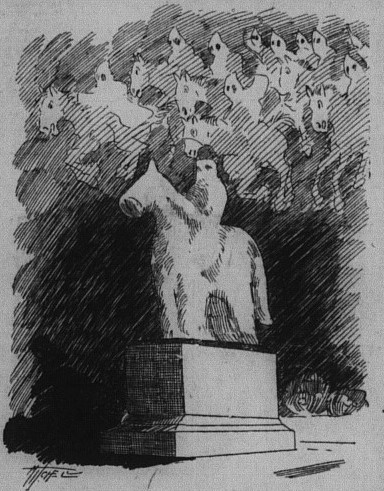
You can object to my assertions on the grounds that we are in no way accountable for the sins of the father, but how can we deny that the noble symbolism of this particular monument is forever tainted by an image that was considered appropriate matter for a city newspaper?


One last question: How can Memphis be expected to embrace her Confederate Heritage, if we can’t bring ourselves to own our History?

Peace Y’all

Thursday, January 11, 2018

Rule Of Law: a Quizzical Survey

Here's an opportunity for you to test your knowledge of that vaunted concept we call "rule of law," and the History that shaped it. 

It's really just a survey, but once you're finished, I'm going to tell you how to grade it anyway (I promise I won't record your scores and turn them into St. Peter at the end of the semester).

Six multiple choice items -- Go

1.         The 13th Amendment to the Constitution was ratified in 1865 because of
A.    Slavery
B.    Black people
C.    White people
D.    Harriett Tubman

2.         The 14th Amendment to the Constitution was ratified in 1868 because of
A.    Abortion
B.    Black People
C.    White People
D.    Wanda Rushing

3.         The 15th Amendment to the Constitution was ratified in 1870 because of
A.    Russian interference with US elections
B.    Black People
C.    White People
D.    Lymus Wallace

4.         Congress ordered the KKK hearings because of
A.    Poor crop yields
B.    Black people
C.    White people
D.    Bob Church

5.         We had Jim Crow laws because of
A.    A shortage of bird feeders
B.    Black people
C.    White people
D.    Rosa Parks

6.         The US has more black prisoners than other countries have prisoners because of
A.    Drugs
B.    Black people
C.    White people
D.    Kalief Browder

Grading Guide
Come on y’all, it’s multiple choice. Don’t you know the answer is always -- SEE?
If you did answer C, there’s a good chance you can develop an honest, educated Historical perspective that will actually come in handy as the World moves ahead -- which it’s going to do with or without you.
If you answered A or D, you are either a smart ass, or someone taught you a lot of wrong things. Good news: this blog can help you with that.
If you answered B, I don’t have time for your cracker ass unless you change your attitude. How’s that for separate and equal -- BEOTCH?

Now for the Shelby County Bonus Question:
Memphis is the black half of a segregated county because of
A.    The appeal of double taxation
B.    Black people
C.    White people
D.    The Memphis 13

So, how’d you do? Do you think you’re ready to learn our History, and learn to share our History?

Feel free to share your grades and discuss your answers in the comments section or on Facebook, and I’ll do my best to respond to your questions, if not right away, then in future posts.
A question for you:
The paradigm is shifting, and the narrative is being rewritten. My question to you is, are we going to participate in writing this new, shared History, or would we rather be written out of it?


Peace Y'all

Tuesday, December 26, 2017

History and Heritage: Redux

This is an interesting situation; the one revolving around the statue of N. B. Forrest.

On the one hand, you have the Sons of Confederate Veterans and other like minded people appealing to History and Heritage and Historical Preservation in defense of the statue...oh, and don't forget The Law.

On the other hand, we have people like Tami Sawyer saying she's glad to see that people in Memphis want to bridge the racial divide, but that we still need to have a conversation on why the divide exists.

Cool. Let's start with the history and heritage of the statue itself.


It was 1905. Bob Church was still the Boss of Beale St.

N B Forrest was as dead as Congressional Reconstruction.

Ida B. Wells had already been run out of town by the lynch mobs,

and

E H Crump Buggy and Harness Co. was doing well.

Lots of cities were putting up statues in those days. How very Progressive of the good "old" citizens of Memphis to erect a statue of one of their own; and by "good 'old' citizens of Memphis," I mean the vindictive white people who remembered the good old days when it was legal to steal people's lives and sell them on Adams St.

Undaunted by the loss of the "War of Northern Aggression," they pressed on and pushed back against the negro hoard, who for some unimaginable reason didn't want to go bacK to the plantation, so they started a Klub. N B Forrest was the first chief exeKutive officer.

But let's be fair here, all the Klub wanted was to dress up like ghosts and scare a mess black folks out of the city and back to the country where they could find more suitable work...you know, in the cotton fields.

"Yeah, we were just tryin to scare 'em...we didn't kill an awful lot of them...but you should'a seen it that one time when...it was so funny... Such a sight to watch them {insert slur} run!"
Who better to symbolize their heritage than N B Forrest?  All they had to do was put his robes in the famous satchel he always carried, and dress him up like History.

Even after Forrest was dead, and whatever the condition of his soul, the rulers of Memphis couldn't pass up an opportunity to trot the old boy out for the sake of demonstrating  and reinforcing their God granted superiority.

Only, except for the bronze uniform, the statue itself didn't even really symbolize the Civil War, or the brave men who fought for what they believed they believed (not stuttering).

In their minds, the statue symbolized white supremacy, and all the intimidation that implies (why do you think the damn thing faced South Memphis?).

The following is an item that appeared in the Memphis Daily Scimitar the day before the unveiling, so the statue was still covered by a sheet of canvas (or some other whitish fabric).

You can read or skip the whole article below if you want, but I'm going to comment on the sections I've highlighted:

Forrest Again in White Shroud

Memphis News Scimitar 30 Apr, 1905


     Out of the past and back from that mysterious state which men call death, Forrest has come to his own again. Stalwart, strong and invincible, he sits erect on King Philip, overlooking Forrest Park and turning his eagle eye toward the south just as he was wont to do forty years ago when the chaotic conditions of life required the organizing of the Ku-Klux-Klan for the protection of the honor and independence of Southern social conditions.

     Clad in his old Ku-Klux garb, a pall of white that covered horse and rider, the great leader of this secret clan rides once more by night, in moonlight or starlight calling his own to follow him again. It may be only a mirage of a war-loving brain that peoples the park again with spectral men in ghostly garb, but when the midnight hour rings clear across the stillness of the sleeping city the greensward becomes an arena where rank by rank, file by file, the old members of the clan come to follow their leader again, crossing and recrossing from the shadow of the trees to the wider open spaces of light, quiet, irresistible, determined, as of old. From the widely scattered graves they come, the green doors of the turf swinging noiselessly back, and horse and rider coming down the long lanes of the past to answer the call of that leader whose iron hand held the reins of safety over the South when Northern dominion apotheosized the negro and set misrule and devastation to humiliate a proud race. From far and near they come, for who of his old men would not come if Forrest would but call?

     One by one they come from the long green aisles that lead the way to the graves of the Confederate dead in Elmwood, and shod in silence, they weave their way across the streets of the sleeping city to the open place in the park, where the leader waits. From lonely graves down in the valey (sic) they come again, the long white garb fluttering in the night wind -- did you think it only a cloud you saw?

     Old men rise from their sleep in comfortable homes, from soldiers’ refuges and from hospital beds, and in their dreams ride out to meet him again. To watch the park would disappoint you, for what mortal eye may see the soldier-spirit that comes again to its own? You would see only mist-wreathe blowing hither and yon from shadow to shadow, where a file of ghostly men of the Ku-Klux-Klan performed again their intricate evolutions: you would hear only a sigh of the wind where the stern warriors repeated in concert the great, binding oath of the order you would hear only the scamper of tiny animal feet or the sleepy call of a night-bird where the men called together of deeds to be done or wrongs to be avenged: you would hear only the faint rumble of thunder where the great company of horses trampled with pad-softened hoofs across time-hardened turf and granolith walk. A phantasy of the brain you will say, for only to those who know will the sprctral throng and its meaning be known. Only to those can the mysteries of the night be interpreted, for by day one sees only a stalwart figure in bronze and stone draped still in its sculptor’s canvas waiting for the cord to be drawn that will reveal a fitting memorial to a man who served his country with honor and distinction and with his sword carved his name on the walls of the temple of fame in those days of long ago “when knighthood was in flower."                                           A. B.


There is nothing in this entire panegyric that honors one soldier. The soldiers who are mentioned are forever connected to the then defunct terrorist organization.

That's the Nathan Bedford Forrest people saw when they bothered to notice the statue at all. Whether you know it not...whether you want to admit it or not, that's the heritage you're trying to preserve.

As far as The Law is concerned, you got out-politicked period.

The mayor and the Council found a loophole and exploited it. That's politics, and congratulations to them for pulling off a conspiracy in broad fricken daylight. It's the most brilliant thing I've seen all year, and it makes me laugh.

Memphis Daily News

And just so you know, I'm as white as a mayonnaise sandwich. Hell, I like being white, but I hate the idea that some people look at me and see that son-of-bitch, and those like him.

You know the people I'm talking about looking at us funny; perfect strangers who look at us like we're  the white person who put the chip on their shoulder, like it's our Heritage or something.

I wonder what would happen if we just owned the chip...owned our heritage, instead of drawing lines in the HIstorical sand. <hashbrownsNOTMYHERITGE> 


Now, if you want to keep on appealing to History, you go right ahead, because this mayonnaise sandwich is breaking his silence and joining the conversation.

Peace Y'all